
"How fabulous!"
And other lessons of grace I have learned...

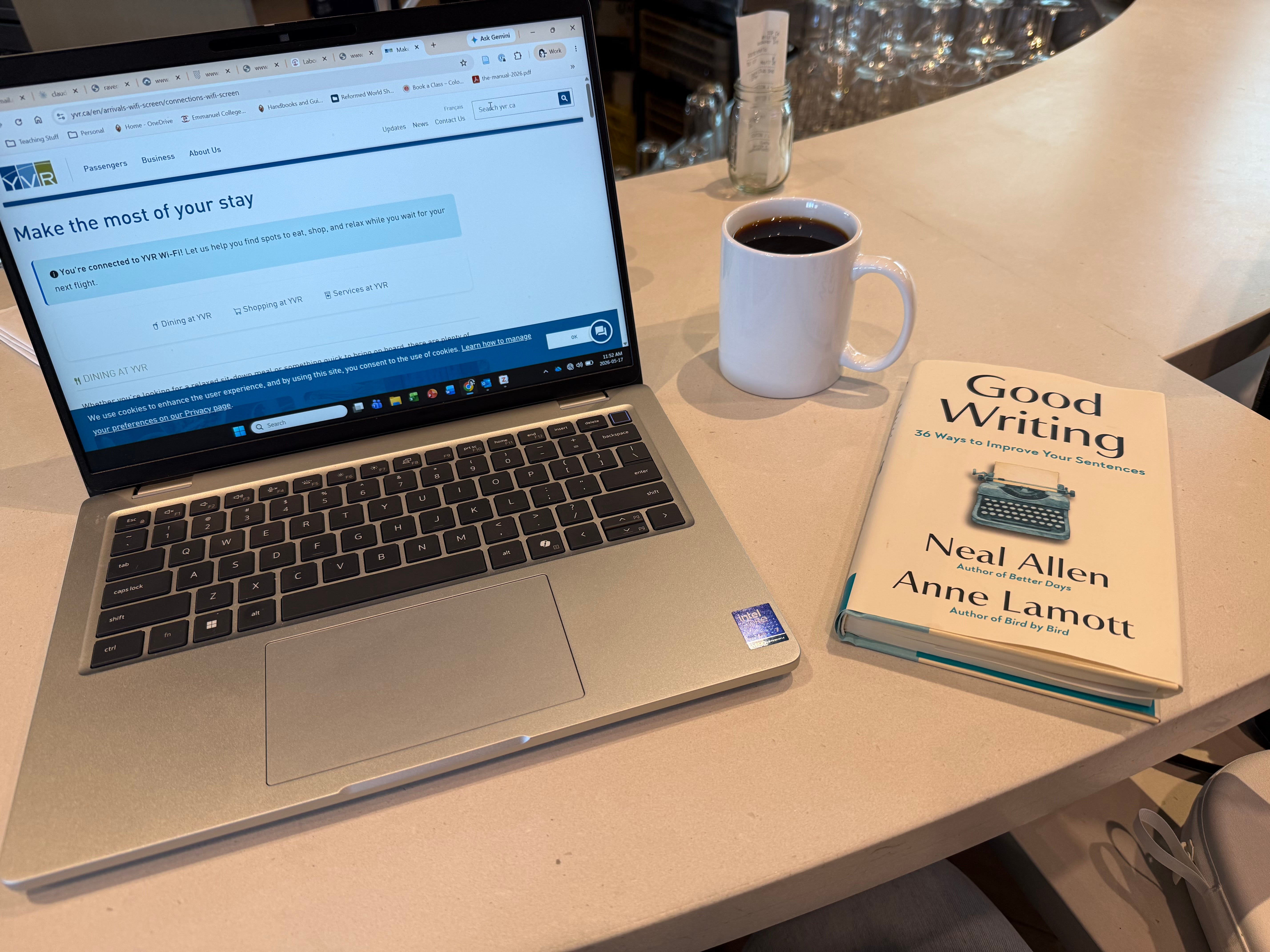
This morning’s Substack is brought to you from the Whistler Taphouse & Grill at YVR (Vancouver International Airport). I’m en route from Winnipeg to the north end of Vancouver Island. Monday to Thursday I’m privileged to be Writer in Residence at the stunning Nimmo Bay Resort.
I’ve been laughing my way through Neal Allen and Anne Lamott’s new book Good Writing: 36 Ways to Improve Your Sentences.
One of the benefits of this Substack, besides the “public theologian” piece of it that is (marginally) in service of the church, is that I am writing more consistently than I ever have. An important practice when 40% of my work is intended to be research and writing.
Learning to be a professor full time after nearly two decades of managerial leadership has wrought a flurry of mistakes. None of them have been catastrophic. At least I’m hoping that no news is be happy on that front.1
I was in Winnipeg over the weekend to lead a couple of workshops and give the closing keynote at a conference. Earlier this week I also turned in not one, but two manuscripts for books to publishers; both were edited volumes, and more work than I anticipated when I started. Throw into the mix two convocation ceremonies at work, and you grasp that I had a Tasmanian devil kind of week.
Normally when I’m busy I’ll pre-write my Substack posts and schedule the 2-3 posts in advance; this gives me grace to not write things at the last minute or to divert too much from what has settled into a 6am Sunday / 6am Wednesday release schedule.
I got last Wednesday’s post written, but then just crash landed into the weekend. I arrived in Winnipeg in the wee hours of Friday morning, 12 hours after the second manuscript was turned in, and without having finished a draft of my keynote for Saturday. How fabulous!
Reading Good Writing is causing my inner perfectionist to break free from the attic where I keep her locked most days. I know my editor hasn’t touched the book yet, and the force is strong within me — a lie whispered over my shoulder that I could claw it back and ‘quickly’ read through the 90,000 word submission to scan for these 36 rules and see how I could tweak it here and there.
Luckily, a boss in a previous life taught me the mantra “Don’t let the perfect be the enemy of the good.” That manuscript was three manuscripts ago, no matter how attached I am to that particular volume as a sole-authored book.
So, as I walked off the plane into a leisurely 2.5 hour layover in Vancouver, I started musing on mistakes and how averse we are to them, generally speaking.
Benjamin Zander and his wife Rosamund Stone Zander wrote a book twenty five years ago called The Art of Possibility: Transforming Professional and Personal Life. One of the techniques they taught Benjamin’s students at the Berklee School of Music and pass on to us through the book was to get over our upright reactions to our own fallibility. The suggest that instead of tensing up and wishing you hadn’t made a mistake, you throw your hands up and exclaim, “How fabulous!!!”
If you’ve seen me speak in church-land over the past three to four years, it’s very likely I’ve done this in church or while giving a speech. Usually I explain, but not always. For example - yesterday while delivering my keynote speech, I realized I had forgotten to address the inherent ableism in one of my illustrations. I stumbled as I acknowledged that talking about ‘violence-blindness’ was an inherently ableist term, and professed I was sorry. I didn’t know how to get back on track and I didn’t want to keep digging myself into that abyss - so I threw my hands up, proclaimed my mantra, and moved on. I’m sure the Mennonites in the room who don’t know that’s my practice thought it was very odd. How fabulous!
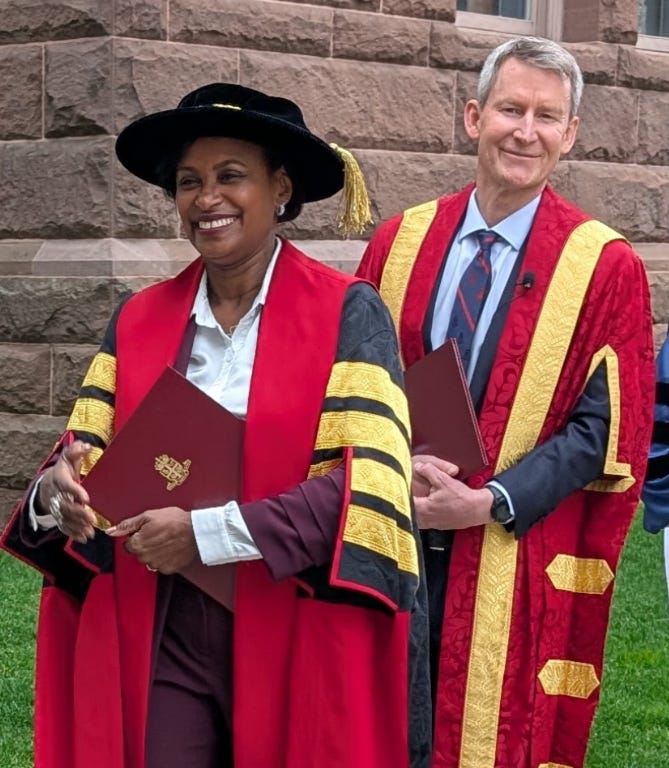
Thursday was our convocation at Emmanuel College. This is Dr. Ronda McEwan, president of Victoria University, and our Chancellor Nick Saul.
For the graduation ceremony, I had agreed to do the Land Acknowledgment and an opening prayer. We were supposed to process onto the stage of Bader Theatre, I was to wait for the students on stage with mobility devices to get settled, then turn to the pianist and nod for him to wind up as I made my way to the podium. I had practiced inviting the gathering to be seated, to say the land acknowledgement and opening prayer, then invite the Chancellor to open the proceedings.
Several things threw me off my game - and they’re not important. But the last in a series of unfortunate events was the pianist wound up before I’d really settled on stage; I panicked when I realized I was up and had to make my way to the podium. My prayer was over the script I had. I acknowledged the land, said my prayer, and left the podium. At which point the President looked at her program, saw that she was up next (the program didn’t note that the Chancellor was to speak in that moment), and she made her opening remarks as we all… continued standing. Awkwardly.
Then the Chancellor realized what had happened, graciously went to the podium, owned my mistake (kind man that he is) and said he’d forgotten to go before the President and invited us to sit as he declared the formalities officially begun.
Aside from the fact that Nick Saul is a gem of a man and I will be forever indebted to his kindness, this was not my easiest mistake to get over. It was my first convocation as tenure-track faculty, and I was proud to be involved in a public way. And I was exhausted and emotional. I wanted to beat the crap out of myself. But as I relaxed into the ceremony and giggled at all the other things that weren’t perfect, I realized two things. First - that I wasn’t alone. No one did anything perfectly. And second - by the end of the 90 minute ceremony, no one remembered we’d all stood for the first five minutes.
We life a risk averse existence. And the sheer volume of existential threat makes that infinitely harder to get over. Truly none of us has ever led a perfect existence (except maybe Jesus and a few other religious figures I don’t know personally enough to call by name).
But we don’t have to give up, either. Saying “How fabulous!” as a moment of grace and an act of forgiveness also allows us a mechanism for starting over and trying better.
So as I head to my next gate to fly north, I own that the sage guidance from Lammott and Allen that I’m reading in Good Writing is for my next book (which I start writing tomorrow). And I share with you that I’ll be taking a break for the rest of the week (not least of my reasons being I’ll be off grid until Thursday).
So whatever grace you need to offer yourself today to get over your necessarily human mistakes, know you have a sibling in fallibility struggling away over here, loving you just the same.
See you all next week!
Anne Lamott — if you do happen to read my post today, you’ll be happy to know I just read the chapter on clichés; I was about to write “No news is good news,” but Bobby McFerrin’s “Don’t Worry Be Happy” was playing of the PA, so I took Neal and your advice. Gracias.